
An active pause at work is a short break, typically 10 minutes or less. It is taken every couple of hours to do light movement, stretching, or mindful breathing. While the benefits come from making these breaks a regular habit, tracking tools can provide an added nudge to stay consistent.
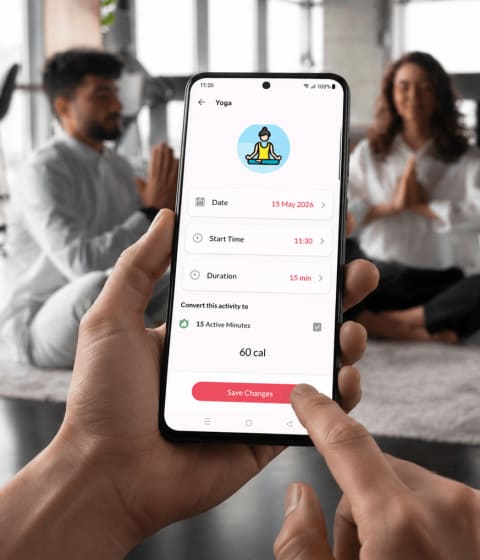
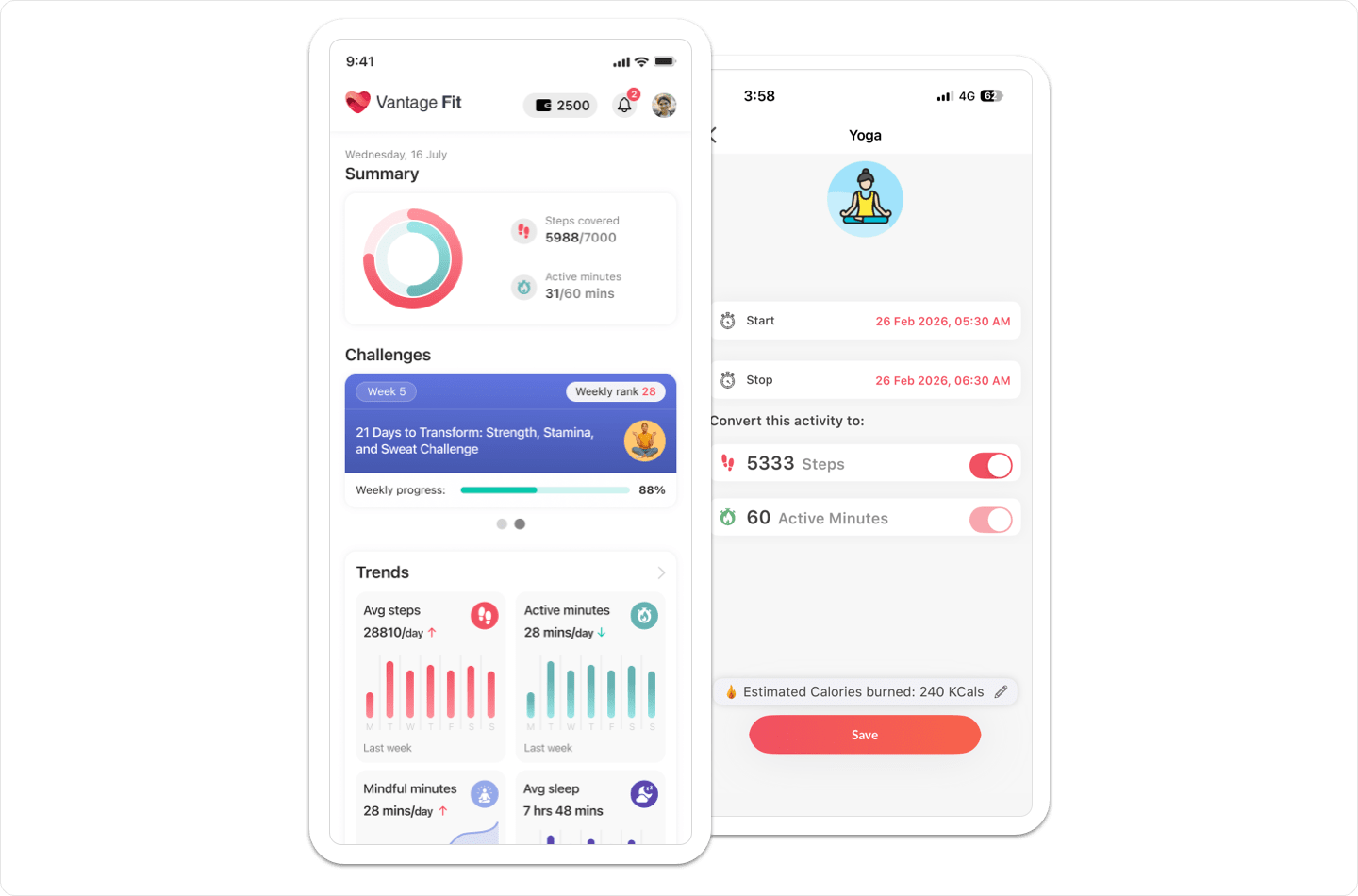
Vantage Fit’s Active Minutes feature helps users track their movement against weekly activity goals, making an otherwise easy-to-skip habit more visible and measurable.
Key Takeaways
- Active pauses are brief, high-frequency breaks (10 minutes or less, every 1-2 hours) built around light movement, not a full workout.
- Employees who get at least 75 minutes of vigorous-intensity activity a week miss an average of 4.1 fewer work days a year, per CDC-backed research.
- Carpal tunnel syndrome affects up to 21% of workers in high-strain manual roles and about 7.8% of the general working population.
- Structured techniques like the 52-17 method and Pomodoro breaks turn active pauses into a repeatable habit instead of a random, easily-skipped break.
- Vantage Fit's Active Minutes feature logs every stretch, walk, and breathing break toward the WHO's 150-minutes-a-week activity target.
Having a healthy lifestyle involves being physically active. A few health benefits can be seen immediately after physical activity, even if it is brief. Because of busy work schedules, lack of self-confidence, or cost-effectiveness constraints, getting physical activity into your daily routine can be challenging.
Long work hours and busy schedules with zero breaks can drain you mentally and physically.
In today's hustle culture, breaks have become things of luxury rather than necessity. As a result, there is a huge burnout and turnout. Every employee needs a break to unwind or catch a breath, and creating a good wellness program would cater to the same.
When it comes to a healthy lifestyle and well-being, pausing is one of the key steps toward it. Taking a pause, be it even for a minute, is necessary to refresh and think with a fresh perspective. It is a healthier way to deal with everyday challenges rather than making decisions in haste.
Did you know that taking an active pause or a mini break from work can help you to be more focused, awake, and happy? Let's discuss an active pause and how your body will thank you for taking a little break in between.
What is an active pause at work?

"Practice the pause, pause before judging, pause before assuming, pause before accusing, pause whenever you're about to react harshly. And you'll avoid doing and saying things you'll later regret.- Lori Deschene"
Active pauses at work are brief exercises or breaks you take during the day to refresh and revitalize your physical and mental performance. Exercise in any form is a stress reliever, and active breaks can help boost endorphins and distract you from your daily worries.
An active pause is a short break at work during which physical activity or mindful meditation is held every two hours of work or screen time. The intensity is not high during the sessions, and the duration is only 10 minutes or less. As part of these sessions, a series of movements activate your muscles and cardiovascular, respiratory, and cognitive systems.
Why are active pauses important?

"Give yourself permission to pause."- Unknown
Periodic breaks are important for your health; contrary to common opinion, they promote productivity, creativity, and energy among employees during working hours. Long working hours and a sedentary life can make them lethargic and sluggish. But active pauses can help to inspire and create a more positive outlook in employees.
The benefits of active pauses at work are multiple, and it goes beyond the square box advantages. It effectively reduces stress and anxiety at work and is a great remedy to prevent the atrophy of body muscles.
Let's take a closer look at how active breaks can benefit your physiological and psychological well-being -
1. Physiological Benefits
Improves sitting postures and routines
Relieves muscle and joint stiffness
Helps stimulate oxygen and blood circulation
Helps prevent headaches and visual fatigue
Prevents carpal tunnel syndrome
2. Psychological Benefits
Helps reduce stress and anxiety
Increases the ability to concentrate at work
Helps promote self-esteem
Promotes social integration
Inspires creativity at work
Benefits of taking active pauses at work
"Taking a break can lead to breakthroughs." - Russell Eric Dobda
There are many benefits of incepting active pauses at work or introducing the concept of it at work as a part of your wellness program. Occupational wellness is essential and prevents occupational hazards in the workplace.
Apart from its ability to increase concentration and focus at work, it also encourages self-esteem and positivity among your employees. Active breaks at work further bridge the gap between your social interaction and create a sense of belonging in the workplace.
Further, active pauses also generate organizational benefits. The program promotes both mental and physical wellness among employees and employers, and it improves adaption to your job profile and improves your employees' qualitative and quantitative performance.
Here are some of the benefits of incorporating active pauses in your workplace wellness culture -
1. It Helps Prevent Visual Fatigue.

"If you get tired, learn to rest, not to quit." ~ Banksy
One of the most common health problems among workers who sit in front of the screen for a long time is experiencing visual fatigue and headaches. It is caused by reduced blinking due to the continuous concentration required to read documents or long exposure to screen time. It further leads to headaches and ocular dryness. To prevent you from becoming visually stressed at work, you can practice active breaks between your work shifts as it barely requires any time or space.
Eye strain builds up gradually from staring at a screen without breaking your focus, so the fix is equally gradual. Short, deliberate eye movements that give your eye muscles a chance to relax and refocus. None of these need special equipment, just a few seconds between tasks.
Here are a few exercises you can do to avoid eye strain at work:
Blink several times a day.
Gently cover your eyes with your hand and move your eyes to the right. Hold your gaze for 5 secs and bring it back to the center.
The movement of your eyes should be smooth and slow.
Repeat it 3 times.
Want to see what consistent active pauses are worth to your team? Use the free Employee Wellness ROI Calculator to estimate the productivity and healthcare savings from building movement breaks into your workday.
2. It Helps Prevent Carpal Tunnel Syndrome.
"Movement is a medicine for creating change in a person’s physical, emotional, and mental states." ~Carol Welch
Workplace ergonomics plays a key role in employees’ health and wellness.The most common reason behind an employee's poor health or posture is their sedentary lifestyle.
Carpal tunnel syndrome affects up to 21% of manufacturing and meat-packing workers, and about 7.8% of workers overall, according to a pooled analysis of six US prospective worksite studies.
It is characterized by pain in the carpal tunnel area that joins the forearm and the hand through which nerves, veins, and tendons cross. It is generally caused by manual activities that require an apprehension or movement of the fingers, often opening or closing, such as when using computers.
However, exercising or stretching can help you keep fit and cope better with working long hours. Implementing short, active breaks in your daily lifestyle is important to help relieve muscle tension.
Since carpal tunnel syndrome builds up from repetitive hand and wrist movement, the most effective prevention is the opposite motion, gently stretching the wrist and fingers in a direction they don't get during typing or clicking. Here are a few offices stretches and exercises that you can practice at work to prevent carpal tunnel syndrome -
Hold your arm straight out in front of you.
Ensure your wrist and hand are straight, and your palm is facing down.
Try to bend your wrist down and stretch it with your other hand.
Hold it for 15-30 secs.
Now return to rest and face your wrist up.
Stretch it upwards and hold it for 15- 30 seconds.
Repeat it 10 times every day.
3. It Helps Improve Physical Posture.
"Stretching exercises promote flexibility, so you move fluidly." -Denise Austin
A sedentary lifestyle can cause many health issues, both physical and mental. One of the most common health concerns among employees who spend almost 8-12hrs at work sitting is either suffering from neck or back pain due to poor physical posture. Back pain is frequent as it is caused by sitting or poor movement of your body throughout the day.
However, a few physical activities in your active pause can help you clear your musculature and improve your posture by relieving stress. These movements specifically target the neck, upper back, and shoulders, the areas that round forward and tighten the most from hours of screen-facing posture, and take under two minutes total.
Here are a few office exercises that you can practice at work to improve your posture:
Try to massage the upper region of your back and posterior neck muscle with the help of both your hands.
Try to do it for 15 seconds.
Now bend your head and gently touch your chest with your chin.
Now push your chin to the right side for 10 seconds and to the left for 10 seconds.
Repeat this exercise 3 times each day.
4. It Helps Reduce Stress.

“Pause, breathe and smile. Anything that adds to your stress is likely not worth pursuing.” ― Majid Kazmi
Workplace stress is inevitable. Everyone experiences some form of stress almost every day, and unmanaged stress can negatively impact your mental health. Stress can be detrimental to your health.
Although human bodies are naturally made to react to stress with the fight or flight response, still prolonged stress can cause a harmful effect on your body and mind. It can cause burnout, mood swings, and even mental exhaustion if not managed. But you can prevent many of the harmful effects of stress by simply pausing.
When stressed or overwhelmed at work, take a short break and focus on your breathwork. It will immediately help you calm down and be more productive.
Breathwork and brief movement both interrupt the stress response directly. It helps slow your heart rate and giving your mind a reset point before you go back to the task at hand.
Here are a few ways you can utilize your active breaks to help you relieve stress at work:
Take a deep breath and pause. It evokes a relaxation response.
When you inhale and exhale, the air fills your lungs and encourages full oxygen exchange in your body.
Try to take 10 deep breaths every day between work. It helps to lower blood pressure and destress.
You can also practice mindfulness meditation at work. During your break, you can plug in any mindfulness session in health apps like Vantage Fit, which offers a variety of 5 to 12-minute sessions.
You can make the best of your active pause to reduce stress simply by taking a brisk walk. Walking even for 5-10 minutes can help trigger the release of endorphins, a feel-good hormone in your body.
Vantage Fit's Active Minutes feature makes it easy to turn these brief pauses into measurable wellness progress. The feature allows logging every desk stretch, walk, and breathing break against the WHO's recommended 150 minutes of moderate-intensity activity per week.
Employees who get at least 75 minutes of vigorous-intensity physical activity a week miss an average of 4.1 fewer work days a year, according to a CDC-backed workplace health research review.
Dr. Suraj Gogoi, a holistic psychiatrist and transformational coach, makes the case for why employers hold the key to making active pauses a workplace norm:
"Employers have a lot of potential to help their employees lead healthy lifestyles. Flexible working hours, encouragement to take breaks, free healthy snacks, access to water, recreational facilities — these are small approaches, but they can be quite impactful."
— Dr. Suraj Gogoi, Transformational Coach & Holistic Psychiatrist | Listen to the full episode
Active microbreak ideas at work
Unlike a full lunch break, one can take microbreaks throughout the day with or without the help of any special equipment or space. Research shows that employees who take regular microbreaks are seen to have higher focus and lower fatigue at the end of a working day.
Here are practical microbreak ideas you can try between tasks or every 45–60 minutes of focused work:
Eye relaxation: Look away from your screen and focus on an object at least 20 feet away for 20 seconds. Repeat three times. This follows the 20-20-20 rule and effectively reduces eye strain due to too much screen time.
Shoulder rolls: Roll your shoulders backward 10 times. Then roll your shoulders forward 10 times to release tension built up in the shoulder area.
Neck side stretch: Gently tilt your head toward one shoulder, hold for 10 seconds, and repeat on the opposite side. This stretch relieves neck stiffness from looking at a screen for long periods.
Box breathing: Inhale for 4 counts, hold for 4, exhale for 4 through your mouth, hold for 4. Make sure that one round should be of at least 20 seconds. This technique is known to immediately lower cortisol levels.
Standing reset: Stand up, push your chair back, and stretch your arms overhead. Simply breaking away from the sitting posture momentarily is enough to reset the body.
Hydration pause: Avoid keeping a bottle at your desk, if possible. Instead, try walking to the pantry or water dispenser area to hydrate yourself. Even a 2-minute walk counts as a legitimate active microbreak.
Mindful minute: Close your eyes for 60 seconds and focus only on your breathing. No screen, no phone.
For more ideas that fit into 5 minutes or less, explore on my colleague's take on 5-minute wellness activities for the workplace.
A simple desk stretch routine
A desk stretch routine is a set of targeted movements you can practice right at your desk. This routine relieves tension around the neck, shoulders, wrists, and lower back area.
Practice this sequence every 2 hours:
1. Neck Stretch (1 minute): Sit upright in your chair. Incline your neck sideways toward your right shoulder and hold for 15 seconds. Switch sides. Then gently tuck your chin toward your chest and hold for 10 seconds.
Avoid full neck rotations. Lateral and forward stretches are safer and sufficient.
2. Chest Opener (30 seconds): Interlace your fingers behind your head and draw your elbows back gently. Hold for 20–30 seconds. This resets the forward-rounding posture that builds up from long hours of typing.
3. Seated Spinal Twist (1 minute): Sit up straight. Place your right hand on the outside of your left knee. Then, twist your upper torso gently to the left, looking over your left shoulder. Hold for 20 seconds. Repeat on the other side.
This releases lower back tension that accumulates from prolonged sitting.
4. Wrist and Forearm Stretch (1 minute): Extend your right arm straight out with your palm facing up. Use your left hand to gently pull your fingers back toward you.
Hold for 15 seconds. Then reverse and pull the fingers down. Switch arms. This stretch targets the tendons most stressed by keyboard use and can help prevent repetitive strain.
5. Hip Flexor Stretch (1 minute): Sit forward in your chair so your left leg can extend slightly behind you. Push your hips gently forward and hold for 20 seconds. Switch sides.
Sitting for long hours tightens the hip flexors, which contributes directly to lower back pain over time.
6. Calf Raises (30 seconds): Keep both feet flat on the floor. Now, slowly raise your heels as high as you can and lower them back down. Aim for 15 repetitions.
This stimulates circulation in the lower legs, and reduces the risk of blood pooling from long sitting periods.
For added benefit, look out for exercise equipment for your desk.
Active pause techniques that work at the office
These are active pause techniques that can help you build a repeatable habit. Say goodbye to those random breaks that get skipped sometimes when work gets busy.
The 52-17 Method: Studies tracking highly productive employees found that they worked in focused bursts of 52 minutes. After that, they tend to take a 17-minute break during which they remain fully disconnected from work. To try this, set a timer and treat your active pause like a scheduled meeting. It should be non-negotiable and planned in advance.
Movement Stacking: For this, pair your daily work task with a physical movement. Every time you send an email, do 10 shoulder rolls. Every time you join a call, do 5 seated spinal twists before unmuting. Stacking movement with your daily tasks means you don't need extra effort to start. The existing cue triggers the action.
The Pomodoro Active Break: The Pomodoro technique involves 25 minutes of focused work followed by a 5-minute break. For this, walk to a different room, or do a few standing stretches. Or else, refer to the wrist and forearm stretch routine in the above section.
Micro-Progressive Movement: This technique involves taking four 2.5-minute movement breaks spread across an hour. This keeps your body continuously active at a low intensity rather than sitting stiff for 55 minutes and then suddenly stretching for 5 minutes. It is particularly effective for reducing lower back fatigue among employees with long desk hours.
Breathwork Anchor: Set a recurring 90-minute reminder. When the alarm goes off, stop your work. Take 10 slow diaphragmatic breaths. This technique takes under 90 seconds and has a measurable calming effect on the nervous system. You can pair this activity with a standing stretch for maximum benefit.
Summing it up
"Time will always continue to flow and it is important that we stop to take a deep breath and allow our minds to breathe as well.- Anonymous"
Therefore, physical activity at work contributes to the well-being of your employees. It is important that your workplace culture encourages more movement and breaks throughout the day in order to promote a healthy workforce and increase productivity.
Frequently Asked Questions
What are active breaks?
Active breaks are short, deliberate pauses, typically under 10 minutes, where light movement, stretching, or breathing replaces sitting still. Unlike scrolling on your phone, they change your body's posture and heart rate, which is what makes them effective at cutting stiffness, eye strain, and mental fatigue.
How often should I take breaks at work?
Most guidance points to breaking up focused work every 45-60 minutes with an active pause of 2-10 minutes. Structured rhythms like the 52-17 method or the Pomodoro technique give you a repeatable schedule instead of waiting until you're already fatigued to stop.
Is it healthy to take a break from work?
Yes. Regular breaks reduce stress and eye strain, and research on office workers links active breaks specifically to lower sedentary time and better perceived productivity. Skipping breaks to push through tends to backfire, since fatigue and reduced focus build up the longer you sit still.
How can I stay healthy while working a desk job?
Combine movement with your existing routine: stand and stretch every 45-60 minutes, take a short walk, and do a few desk stretches for your neck, wrists, and back. Pairing this with a tracking tool like Vantage Fit's Active Minutes makes it easier to see whether you're actually hitting your weekly activity target.
It is beneficial for both you and your organization to encourage your employees to take active pauses while they are at work. As it helps them to pause and revatilize their energy and refresh their mind.
I hope this article helped you understand and get an insight to what active pause is and how it can benefit you and your employees.